


TB-500 (10mg)
$90.00
In stock
Ships same-day if ordered before 12 PM EST. Estimated delivery: 2 - 5 days
TB500-10
Description
Chemical Information
Shipping Information
What Is TB-500 and What Does It Do?
TB-500 is a synthetic version of a naturally occurring peptide called Thymosin Beta-4, which plays a key role in tissue repair and regeneration. It is found in high concentrations in wound sites, where it supports cell migration, inflammation modulation, and blood vessel formation.
In research settings, TB500 is studied for its ability to promote recovery in muscle, tendon, and skin tissue. Scientists are particularly interested in its influence on actin polymerization, an essential process for cell movement and structure.
By promoting actin regulation, TB 500 may help accelerate the repair of damaged tissues in controlled lab models.
Disclaimer: Evolve Peptides sells TB-500 for laboratory research only. This peptide is not approved for human use or therapeutic applications. |
TB‑500 Mechanism Of Action (Based on Research)
TB‑500 is a synthetic peptide modeled after the naturally occurring protein Thymosin Beta‑4 (Tβ4), a key regulator of actin dynamics and cellular repair processes. In biological systems, Tβ4 is highly conserved and plays a pivotal role in wound healing, tissue regeneration, inflammation modulation, and angiogenesis.
Unlike many signaling peptides that act through membrane-bound receptors, TB‑500 primarily works by binding to G-actin monomers inside cells, sequestering them and influencing cytoskeletal behavior. This mechanism allows cells to reorganize rapidly, migrate to injury sites, and begin tissue reconstruction, processes that are essential for healing and regeneration.
Research Applications (TB-500 Benefits)
TB-500 has demonstrated a range of biological effects that support tissue repair and regeneration. Researchers have observed accelerated wound healing, reduced inflammation, and improved flexibility in soft tissues like muscle, ligaments, and tendons.
Accelerated Wound Closure & Angiogenesis
In preclinical injury models, Thymosin Beta-4 (TB-500) significantly enhanced the rate of wound closure compared to controls
According to one study, TB-500 not only promoted faster re-epithelialization but also reduced neutrophil infiltration and suppressed inflammatory cytokines such as IL-1β and MMP-9.
This suggests that TB-500 supports tissue repair through both accelerated cell migration and modulation of the local inflammatory environment. These dual actions, particularly faster wound healing and reduced inflammatory damage, make TB-500 a compelling candidate for further investigation in regenerative medicine.
Enhanced Cell Migration & Actin Regulation
TB‑500 enhances keratinocyte migration, which is a critical step in closing wounds. It functions by binding and releasing actin monomers, facilitating actin filament assembly and boosting cell mobility, which researchers link to improved tissue regeneration.
A 2017 study in Scientific Reports examined TB‑500’s molecular effects, uncovering its role in actin dynamics and cell motility.
TB‑500, derived from the highly conserved actin-binding motif LKKTET within Thymosin β4, functions by sequestering G-actin monomers. This reservoir mechanism allows precise control over actin polymerization, fueling cellular movement when required.
By modulating the balance between G‑actin and F‑actin, TB‑500 aids in focal adhesion formation and cytoskeletal reorganization — key processes for directed cell migration.
In several cell models, increased TB‑500 activity boosted integrin-linked kinase signaling, enhancing migration, invasion, and angiogenic capacity.
Anti‑Inflammatory & Anti‑Scarring Properties
Preclinical models show TB‑500 reduces inflammation, apoptosis, and fibrotic scar tissue while encouraging stem cell activity. It also elevates VEGF and MMP expression, further supporting tissue repair processes.
In a detailed animal study, oxidized forms of Thymosin β4 ( UTβ4 and LTβ4) were found to reduce inflammation significantly. In one test using a λ-carrageenan footpad model, LTβ4 reduced swelling by up to 58% within 24 hours, and its effects lasted through 48 hours. UTβ4 also reduced inflammation, but not as strongly.
Across several models, including contact dermatitis, LTβ4 consistently outperformed UTβ4, suggesting it has greater anti-inflammatory strength.
Researchers believe this effect comes from the oxidation of certain amino acids (specifically methionine), which helps block neutrophil movement and lowers the number of inflammatory cells at the injury site, possibly acting as a natural feedback mechanism during tissue repair..
Remember TB‑500 is for laboratory research only. It is not approved for human or veterinary therapeutic use.
Diverse Organ & System Repair
Beyond its well-documented benefits for skin, TB‑500 has demonstrated regenerative promise in cardiac, neural, and diabetic contexts. Notably, in a mouse model of type II diabetic peripheral neuropathy, Thymosin β‑4 (TB‑500) significantly improved blood flow and microvascular density in the sciatic nerve by upregulating angiopoietin‑1 while suppressing angiopoietin‑2.
This vascular enhancement facilitated improved motor and sensory nerve function. The authors attribute these effects to activation of the PI3K/Akt pathway in endothelial and Schwann cells, highlighting a clear mechanism by which TB‑500 promotes neurovascular repair and functional recovery in diabetic neuropathy.
Peripheral Nerve Regeneration
In a diabetic neuropathy model, administration of Thymosin Beta‑4 improved sciatic nerve conduction velocity—indicating enhanced nerve function—while boosting microvascular density in nerve tissues.
Cardiac Repair & Epicardial Activation
Landmark studies on mice with induced myocardial infarction demonstrated that TB‑500 preserves cardiomyocytes, activates epicardial progenitor cells, and stimulates epicardial thickening—mimicking embryonic heart development. This results in improved cardiac function and neovascularization post-injury.
Broader Organ Regeneration Potential
TB-500 shows potential in promoting repair in brain and kidney tissues by engaging developmental and angiogenic pathways. In cardiac tissues, it even reactivates embryonic signaling in adult hearts, hinting at anti-aging applications and broader regenerative uses.
TB‑500 Peptide Characteristics
- Chemical Formula: C212H350N56O78S
- CAS Number: 77591-33-4
- Amino Acid Sequence: SDKPDMAEIEKFDKSKLKKTETQEKNPLPSKETIEQEKQAGES
- Synonyms: Thymosin Beta-4 Acetate, Tβ4, TB4
- Molar Mass/Molecular Weight: 4963.44 g/mol
- Storage Recommendations:
- Lyophilized Form: Store at -8°C (46°F) or below in a sealed, desiccated container for long-term stability.
- Reconstituted Solution: For short-term use, store at 35.6-46.4°F (2-8°C) and use within 14 days.
- For extended storage, Freeze at 68°F (−20°C). Avoid repeated freeze-thaw cycles.
TB‑500 vs BPC‑157 vs Thymosin Alpha‑1 Comparison
Feature | TB‑500 | BPC‑157 | Thymosin Alpha‑1 |
Peptide Type | Synthetic fragment of Thymosin β4 | Synthetic pentadecapeptide from body protection compound | Synthetic version of Thymosin α1 |
Primary Focus | Tissue repair, cell migration, angiogenesis | Gastrointestinal healing, tendon/ligament repair, angiogenesis | Immune modulation, antiviral activity |
Mechanism | Binds G‑actin, regulates cytoskeleton and cell movement | Promotes VEGF expression, nitric oxide modulation | Enhances T-cell function, IFN‑γ regulation |
Research Use Cases | Muscle/tendon healing, cardiac repair, nerve regeneration | Gut integrity, soft tissue recovery, CNS inflammation | Cancer immunotherapy, chronic infection studies |
Inflammation Modulation | Moderate (via oxidized forms) | Strong (gut + systemic) | Strong (especially in immune contexts) |
Molecular Weight | ~4,921 Da | ~1,419 Da | ~3,108 Da |
CAS Number | 77591‑33‑4 | 137525‑51‑0 | 62304‑98‑7 |
TB-500 Safety and Side Effects in Studies
Most available data on TB‑500 comes from preclinical animal models and limited in vitro studies. At typical research-level dosages, TB‑500 has generally been well-tolerated in these settings, with no major adverse effects consistently reported.
Some studies have noted normal physiological responses such as mild inflammation during the healing process, but no toxic effects, organ damage, or systemic immune disruption have been documented under controlled experimental conditions.
However, due to the lack of human clinical trials, no definitive safety profile can be established for human use. The peptide’s long-term effects, potential for off-target activity, or interactions with other biological systems remain largely unstudied.
Legal Disclaimer
This product is intended for laboratory research purposes only and is not approved for human or veterinary use. It is not to be used for diagnostic, therapeutic, or clinical applications, and must not be resold or repackaged for any such purpose.
By purchasing this product, the buyer agrees to use it in accordance with all applicable laws and regulations governing research chemicals.
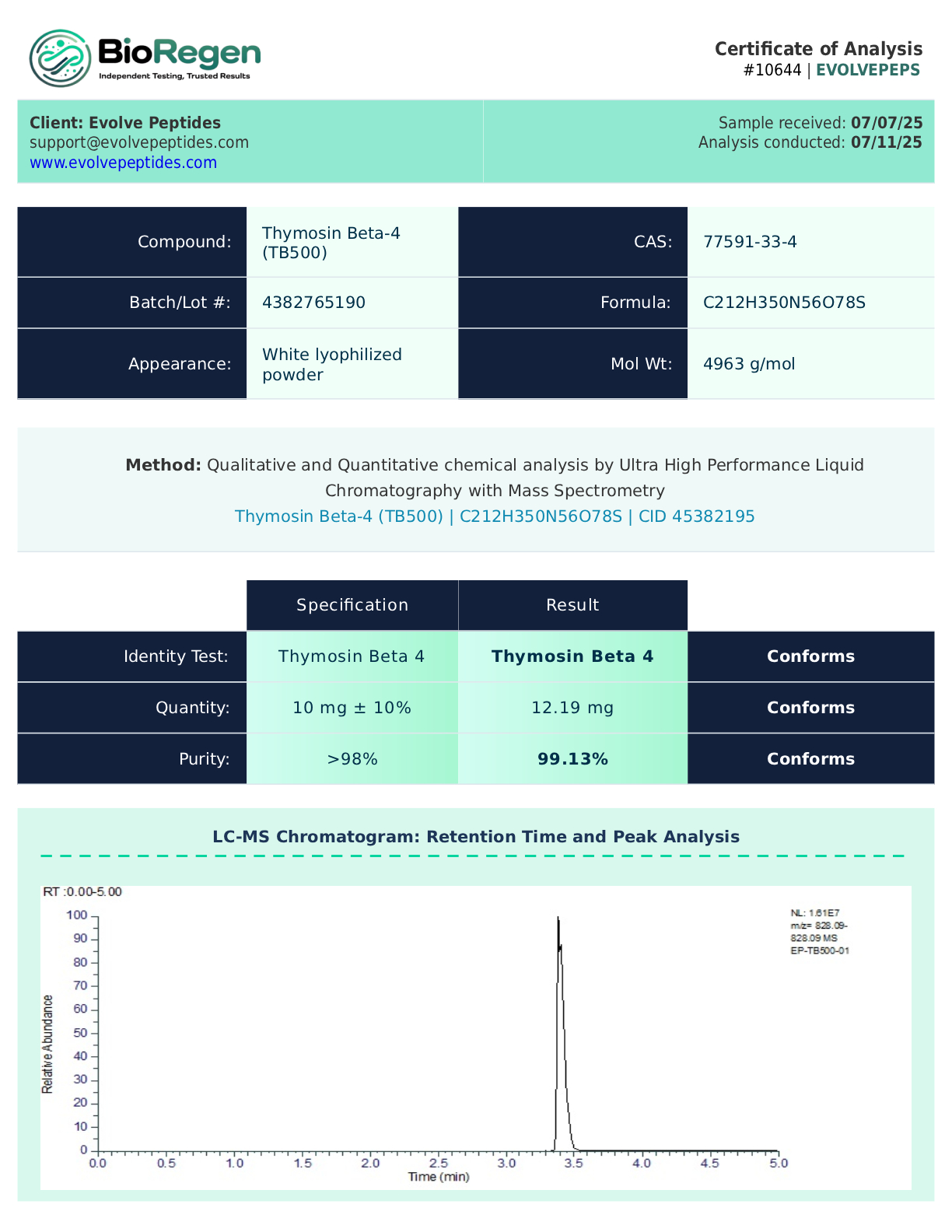
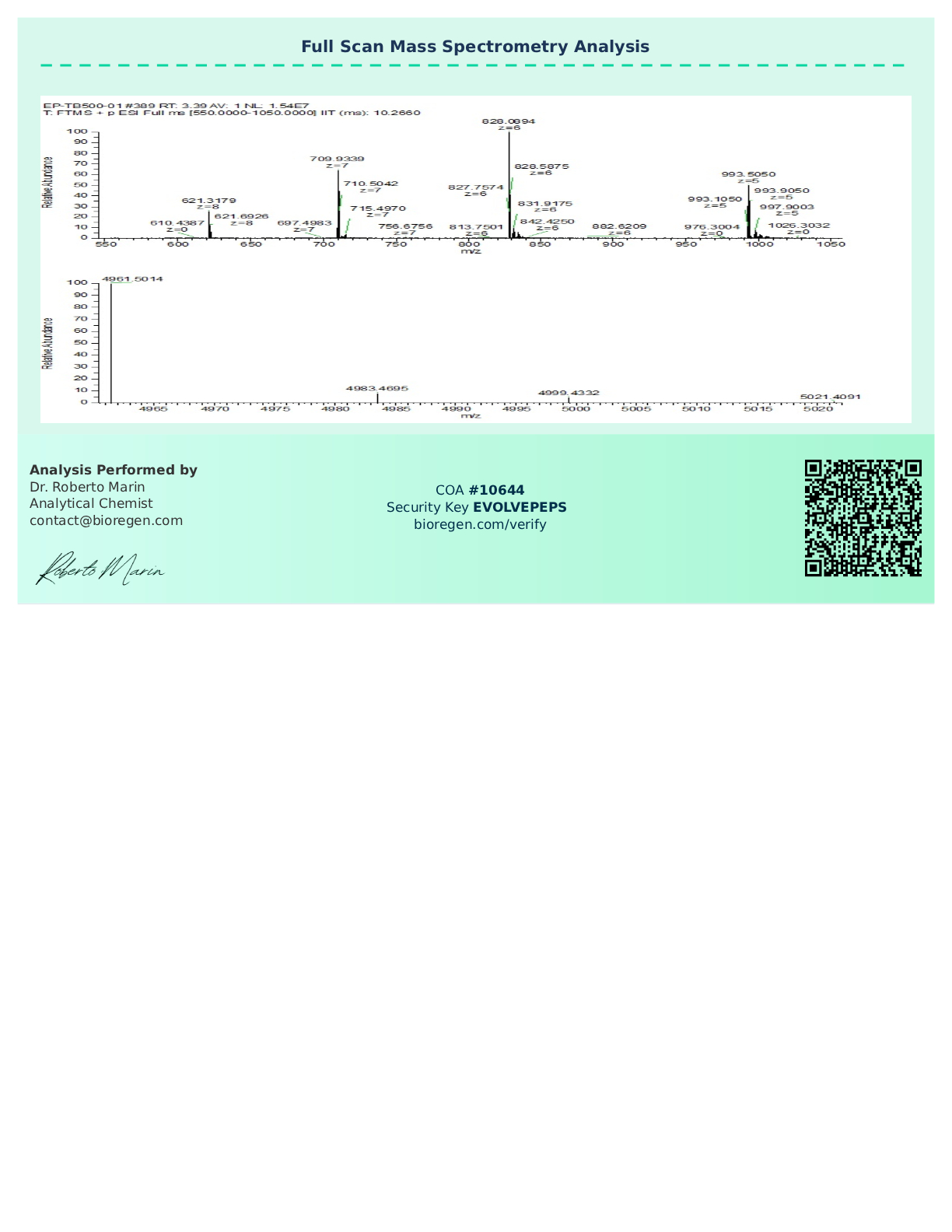
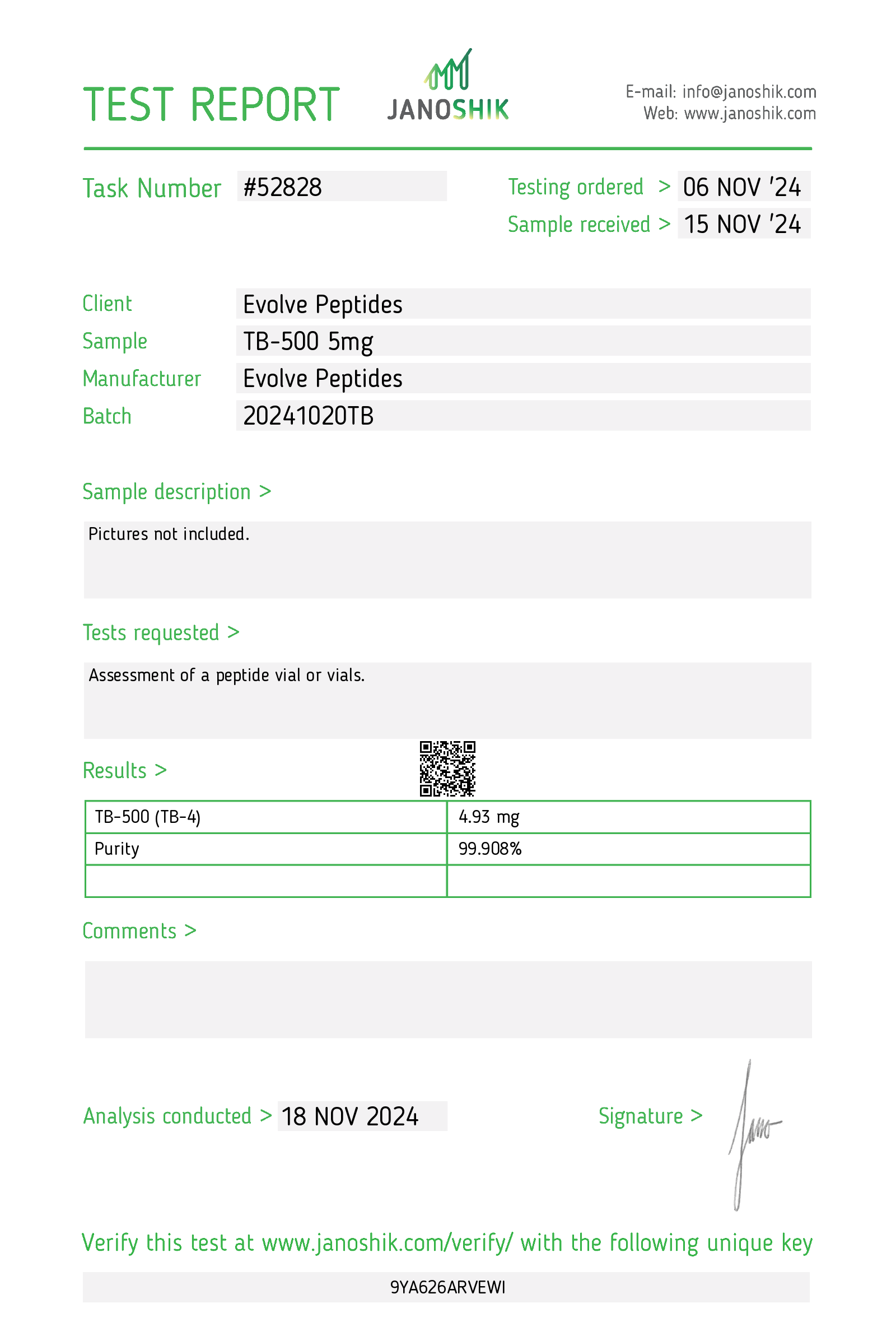
Certificate of Analysis (COA)
At Evolve Peptides, every batch of TB‑500 undergoes third-party laboratory testing to verify purity, identity, and quality. These tests are conducted using validated analytical methods such as HPLC and mass spectrometry, ensuring results you can trust for research applications.
We maintain strict sourcing and manufacturing standards, and our COAs consistently confirm purity levels exceeding 99%.
For transparency and scientific rigor, we make Certificates of Analysis available upon request or directly downloadable on applicable product pages.
Scientific References
- Rossdeutsch, A., Smart, N., Dubé, K. N., Turner, M., & Riley, P. R. (2012). Essential role for thymosin β-4 in regulating vascular smooth muscle cell development and vessel wall stability. Circulation Research, 111(e89-e102).
https://www.ahajournals.org/doi/10.1161/CIRCRESAHA.111.259846 - Shin, S.-H., Lee, S., Bae, J.-S., Jee, J.-G., Cha, H.-J., & Lee, A. Y. M. (2014). Thymosin β-4 regulates cardiac valve formation via endothelial-mesenchymal transformation in zebrafish embryos. Molecules and Cells, 37, 330-336.
https://www.sciencedirect.com/science/article/pii/S1016847823053153?via%3Dihub - Smart, N., & Riley, P. R. (2021). Utilizing developmentally essential secreted peptides such as thymosin β-4 for adult tissue repair and regeneration. Cells, 10 (6,1343. PMCID PMC8228050
https://www.mdpi.com/2073-4409/10/6/1343 - Raheem, N. N., Salman, A. S., & Jawad, M. H. (2024). Histological Evaluation of Effect of Thymosin Beta 4 on Wound Healing of Skin. European Journal of Dental and Oral Health, 5(3), 1-7.
https://ejdent.org/index.php/ejdent/article/view/330 - Sosne, G., & Kleinman, H. K. (2015). Primary mechanisms of thymosin β4 repair activity in dry eye disorders and other tissue injuries. Investigative Ophthalmology & Visual Science, 56(9), 5110-5117.
https://iovs.arvojournals.org/article.aspx?articleid=2423767
- Riley, P. R., & Smart, N. (2009). Thymosin beta‑4 induces epicardium‑derived neovascularization in the adult heart. Biochemical Society Transactions, 37(Pt 6), 1218-1220.
https://portlandpress.com/biochemsoctrans/article-abstract/37/6/1218/64972/Thymosin-4-induces-epicardium-derived - Xu, G. J., Hannappel, E., Morgan, J., Hempstead, J., & Horecker, B. L. (1982). Synthesis of thymosin β‑4 by peritoneal macrophages and adherent spleen cells. Proceedings of the National Academy of Sciences of the United States of America, 79(13), 4006-4009.
https://www.pnas.org/doi/abs/10.1073/pnas.79.13.4006
- Low, T. L., Hu, S. K., & Goldstein, A. L. (1981). Complete amino acid sequence of bovine thymosin β‑4: a thymic hormone that induces terminal deoxynucleotidyl transferase activity in thymocyte populations. Proceedings of the National Academy of Sciences, 78(2), 1162-1166.
https://pmc.ncbi.nlm.nih.gov/articles/PMC319967/
- IUPAC InChI and chemical data for thymosin β‑4. (n.d.). PubChem Compound Summary. Retrieved [date], from https://pubchem.ncbi.nlm.nih.gov/compound/Thymosin-beta4#section=IUPAC-Name
Contents: 10 mg lyophilized (freeze-dried) powder provided in a 3 ml vial, sealed and sterile. Purity exceeds 99%, guaranteed.
Notes: Requires reconstitution with bacteriostatic water. (Sold here: BAC Water.)
Chemical Formula: C212H350N56O78S
PubChem CID: 16132341
CAS Number: 77591-33-4
Molecular Weight: 4963.44 g/mol
Storage: Store at ≤8°C, sealed, away from heat, light, and moisture. The colder the better.
Purity: >99%
Orders placed before 1 PM EST ship same day.
We use USPS for most of our deliveries. You can expect your parcel within 2-5 business days from when it leaves our warehouse.
Why Choose Us?
Lyophilized in Texas – 99%+ Purity Guaranteed
Our peptides are proudly lyophilized right here in the US, to exact specifications. Strictly no compromises.
Rigorously Third-Party Tested, Always
Every product page includes independent lab test results for every peptide we sell.
We Respond in Minutes, Not Days
We take pride in providing excellent support – we're here for your total research success.
200% Money-Back Guarantee
Test our product – if purity doesn't match the label, we refund 200%. No questions asked.
Related products
-
 Save $90.00
Sema 10 mg
$219.90Original price was: $219.90.$129.90Current price is: $129.90.Save $90.00 -

 Save $50.00
 -
 Save $60.00
